


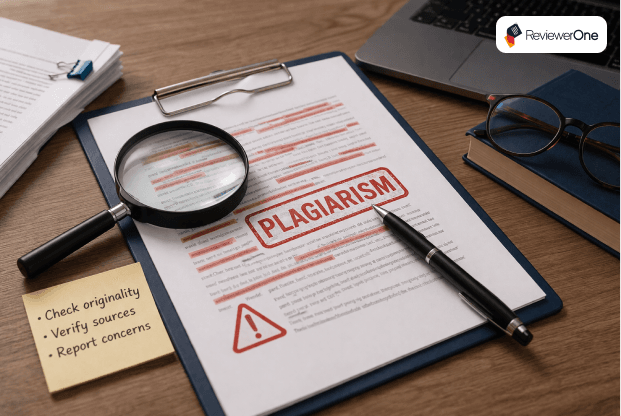
Plagiarism is one of the most common forms of research misconduct. While automated tools help identify clear text overlaps, subtler forms of plagiarism, such as appropriating ideas without attribution, reframing another researcher’s argument as original thinking, or recycling an author’s own previously published work, are harder to identify without sufficient context. As a peer reviewer, you may come across sections or content that sounds vaguely familiar or like it might not be original. It is important for you to know how to deal with such cases.
What counts as plagiarism?
Plagiarism occurs when authors present someone else’s work, words, data, or ideas as their own, without proper acknowledgment. This is a broad definition, and it covers a spectrum of behaviors that go beyond direct text copying.
At the most straightforward end is verbatim reproduction – text copied from another source and presented without quotation marks or a citation. However, reviewers should also watch for paraphrasing that is too close to the original, for example, when key phrases or a sequence of arguments is borrowed, even if individual words have been changed, or when theoretical frameworks, hypotheses, or research designs from others are appropriated without attribution.
The situation gets more complicated in the case of self-plagiarism, which COPE treats as a related but distinct concern. Text recycling, where authors reuse content from their own previously published work, may not always be problematic. Reproducing standard methodological language from a prior paper is widely accepted. However, reproducing results, conclusions, or substantive arguments from a prior publication and presenting them as new research is a more serious matter, because it misrepresents the contribution and can distort citation metrics and evidence bases. The COPE flowchart on plagiarism in submitted manuscripts distinguishes between minor overlaps and clear plagiarism and treats them differently in terms of recommended editorial responses.
What you need to remember about plagiarism as a reviewer
Plagiarism typically presents in the following forms:
- Direct text overlap with a published paper you recognize or can identify through a quick phrase search on Google Scholar or a publication database
- Arguments or conclusions that closely mirror another paper without an appropriate citation, particularly in the literature review or discussion sections, where your own reading of the literature may reveal the source
- Methods sections copied verbatim (or near verbatim) from a prior publication by the same or different authors without attribution
- Reproducing content from published review articles without quotation or citation
- Figures or tables that appear to duplicate or closely replicate published visuals without appropriate attribution or permission
- Undisclosed dual publication, where the same or a very similar manuscript is submitted to multiple journals simultaneously (simultaneous submission), or a study on the same topic with the same findings has been published in another language.
As a peer reviewer, you may or may not be able to identify such cases, and that is fine. However, if you feel that something doesn’t feel right, bring this to the journal editor’s attention.
The tricky case: Seeing unpublished work you encountered elsewhere
A particularly delicate situation arises if, while reviewing a manuscript, you realize that it seems similar to one you have previously reviewed or are reviewing for a different journal. You may have seen ideas, data, or frameworks in an earlier review that now appear in the current manuscript without attribution.
As a peer reviewer, you have to fulfill your obligation, but without breaching confidentiality. What you can do is inform the editor that you have encountered closely related unpublished work in another context, without revealing its source or contents, and suggest that this may warrant further investigation. The editor can then decide whether to seek additional information.
How to respond: Your role in the process
The COPE flowchart on plagiarism outlines a clear process for editors to follow in the case of suspected plagiarism. It begins with the peer reviewer raising concerns, not conducting a full investigation. As a reviewer, your role is not to accuse the authors, contact them directly, or make a definitive finding of misconduct. Your role is to document your concern with sufficient specificity for the editor to act on it and make a definitive finding of misconduct. Your role is to document your concern with sufficient specificity for the editor to act on it.
In your review, note the specific concern, for example, which passage appears copied or too closely paraphrased, and from which source, if you can identify it. Provide the relevant text from the manuscript and the source, along with a URL. Frame this as a concern requiring the editor’s attention, not as an accusation or a verdict.
If the concern is substantial, particularly if it appears to involve systematic copying or undisclosed prior publication, share it as a confidential comment for the editor field rather than in your review comments for authors. This protects both you and the authors from a premature accusation.
The editor will then investigate and follow the process outlined by COPE: checking whether your concern warrants further investigation, communicating with the authors, and/or involving the authors’ institution if required. Journals that are COPE members are expected to follow this process. You may or may not be consulted further, as editors typically handle subsequent steps without re-engaging the peer reviewer.
To learn more about how real cases of plagiarism were handled, head over to the case studies section on COPE.
If you want to approach peer review with more clarity and confidence, join ReviewerOne and be part of a network that supports peer reviewers. Join the ReviewerOne platform






Leave a Comment