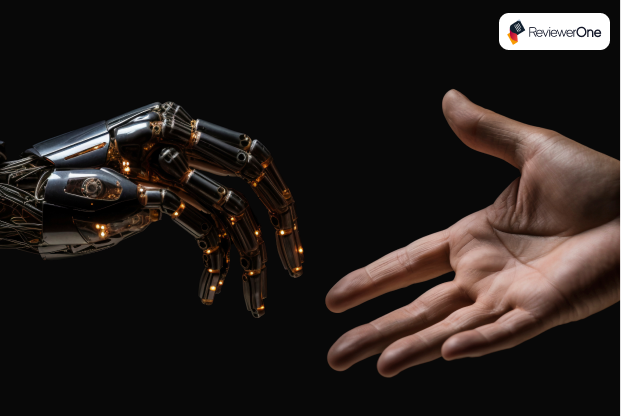
Reviewers do not need technology to decide whether a study is convincing. They need it to reduce the time spent on work that does not require the same level of subject expertise. That is where AI-assisted peer review can be useful. Well-designed peer review technology can surface possible reference issues, reporting gaps, inconsistencies, or other signals for a reviewer to examine. It can support manuscript review without deciding whether the methods are appropriate, whether the evidence supports the claims, or what recommendation a reviewer should make. Used within clear journal policies, AI peer review should protect expert judgment rather than compete with it.
Where can AI-assisted peer review reduce reviewer workload?
AI-assisted peer review is most useful when it reduces repetitive or mechanical work around the review rather than taking over the evaluation itself. A review can require more than reading the argument and assessing the science. Reviewers may also spend time checking references, looking for inconsistencies, moving between sections, verifying whether a concern appears elsewhere in the manuscript, or organizing notes before writing the report. Peer review technology can help surface information that deserves attention. For example, a system may flag a possible reference-integrity issue, identify information that warrants closer inspection, or direct a reviewer to an area that may need further checking.
ReviewerOne is designed around this assistive role. Its AI Review Assistant is positioned to handle mechanical review burden and surface signals around areas such as reference integrity, methodological concerns, and ethical issues, while leaving deeper intellectual evaluation to the reviewer. The value is not that a flag is automatically correct. The value is that the reviewer can decide whether the signal is relevant without spending as much time finding it. This is one practical way to reduce reviewer workload while keeping responsibility with the reviewer.
What should technology never decide in peer review?
Technology should not replace expert judgment about the meaning, quality, or importance of research. Reviewers are invited because they bring subject knowledge, methodological experience, context, and the ability to interpret evidence. Those are the parts of reviewing that determine whether a limitation is serious, whether an analysis is appropriate, whether an explanation is plausible, and whether conclusions are supported.
Peer review technology may point to a possible issue, but it cannot simply determine how much that issue matters in the context of a specific study. A reference check, for example, may flag an older citation. Only the reviewer can judge whether that source is outdated, historically necessary, or still the most appropriate evidence. The same principle applies to methods, statistics, ethical concerns, and interpretation. AI peer review can provide signals. Expert judgment has to determine what those signals mean.
The Committee on Publication Ethics (COPE) describes peer reviewers as central to the integrity of the scholarly record and states that reviewers should conduct reviews ethically and accountably. Its guidance also emphasizes confidentiality, journal instructions, and objective, evidence-based assessment.
How can reviewers use AI-assisted peer review responsibly?
Reviewers should use AI-assisted peer review only in ways that protect confidentiality, follow journal policy, and leave the final evaluation fully under human control. This matters because unpublished manuscripts are confidential. Reviewers should not assume that any general-purpose artificial intelligence tool is appropriate for manuscript review. That does not make all peer review technology equivalent. A purpose-built workflow may be designed very differently from a public chatbot.
Reviewers still need to understand the journal’s rules, how the tool handles manuscript data, what it is actually checking, and whether its outputs can be independently verified. A useful principle is simple: technology may assist the process, but the reviewer remains accountable for the report. That means checking flagged issues before relying on them, rejecting incorrect or irrelevant suggestions, and never allowing an automated output to become a substitute for reading the manuscript.
Can peer review technology make manuscript review more efficient?
Yes. Peer review technology can make manuscript review more efficient when it protects time for the parts of reviewing that require expert judgment. Efficiency does not mean reading faster or writing a shorter report. It means reducing avoidable work around the review so attention can stay on the research question, methods, evidence, interpretation, limitations, and contribution.
For a reviewer working within limited time, even small reductions in repetitive checking can be useful. A tool that brings a questionable reference directly to attention, for example, may remove several manual steps. A system that organizes potential issues by section can also make it easier to return to the relevant passage and verify the concern.
This approach fits a broader need for better reviewer support. ReviewerOne has previously explored why reviewer support is essential to the future of peer review, including the role of better workflows and carefully designed technology in protecting reviewer time. ReviewerOne has also discussed why global peer review needs flexible reviewer support, including practical tools that reduce repetitive work while leaving interpretation and recommendations to the reviewer. Peer review technology is useful when it gives time back to the reviewer and keeps expert judgment at the center.
Which review tasks are best suited to technology?
The best candidates are tasks that are repetitive, searchable, or based on clearly defined signals. During a review, that may include checking whether references can be verified, surfacing potentially problematic citations, identifying certain reporting inconsistencies, or helping a reviewer navigate back to the relevant section of a manuscript. ReviewerOne’s AI-assisted tools are designed around this kind of support rather than generating the reviewer’s scientific conclusion.
By comparison, deciding whether a study is novel, whether the methodology adequately answers the research question, whether limitations change the interpretation, or whether the conclusions are proportionate to the evidence requires expert judgment. The boundary will not always be perfectly clean. Some signals become useful only after a specialist interprets them. That is why the role of these tools should remain assistive: surface, organize, and support, then leave the decision to the reviewer.
Can technology actually reduce reviewer fatigue?
Technology can help with one part of reviewer fatigue by reducing unnecessary mechanical work, but it cannot solve workload pressure on its own. Reviewer workload is influenced by invitation volume, manuscript complexity, deadlines, competing academic responsibilities, and how efficiently review systems are designed. Peer review technology can improve one part of that environment by making some checks easier, but it cannot create more capacity when a reviewer has already taken on too much.
This is why reducing reviewer workload needs a broader approach. Clear review criteria, realistic timelines, appropriate reviewer matching, accessible guidance, and practical tools all contribute. AI-assisted peer review is one part of reviewer support. It should make specific parts of the process easier without creating pressure to review more manuscripts or complete reviews faster simply because technology is available.
Key takeaways
AI-assisted peer review can reduce reviewer workload when it handles or accelerates mechanical checks and brings useful signals to the reviewer’s attention. The scientific evaluation still belongs to the reviewer. Expert judgment is required to assess methods, evidence, interpretation, significance, limitations, and the importance of any issue a tool flags.
Responsible AI peer review also depends on confidentiality, transparent use, secure workflows, and journal policy. Reviewers should verify outputs rather than accept them automatically. The goal of peer review technology should be straightforward: spend less reviewer time finding and organizing information, and protect more time for the intellectual work that requires qualified human expertise.
Try AI-assisted peer review with ReviewerOne
ReviewerOne combines reviewer support with AI-assisted checks designed to reduce mechanical work during manuscript review while keeping expert judgment with the reviewer. Sign up for ReviewerOne’s AI-assisted peer review platform and explore a workflow designed to support reviewers while keeping human evaluation at the center.